
If you are missing one or more teeth, you may hear your dentist discuss a partial denture, a dental bridge, or another tooth-replacement option.
A partial denture vs dental bridge comparison usually begins with one major difference: a partial denture is removable, while a traditional dental bridge is designed to remain fixed in place.
That difference affects how each restoration is supported, cleaned, and incorporated into daily life. However, removability is only part of the decision.
The number and location of missing teeth, condition of the teeth that remain, gum health, bite, available support, oral hygiene, and your preferences can all influence which option may make sense.
At Stillwater Dental Associates, the goal is not to recommend the same restoration to everyone. Treatment planning should reflect the individual mouth and the patient’s practical needs.
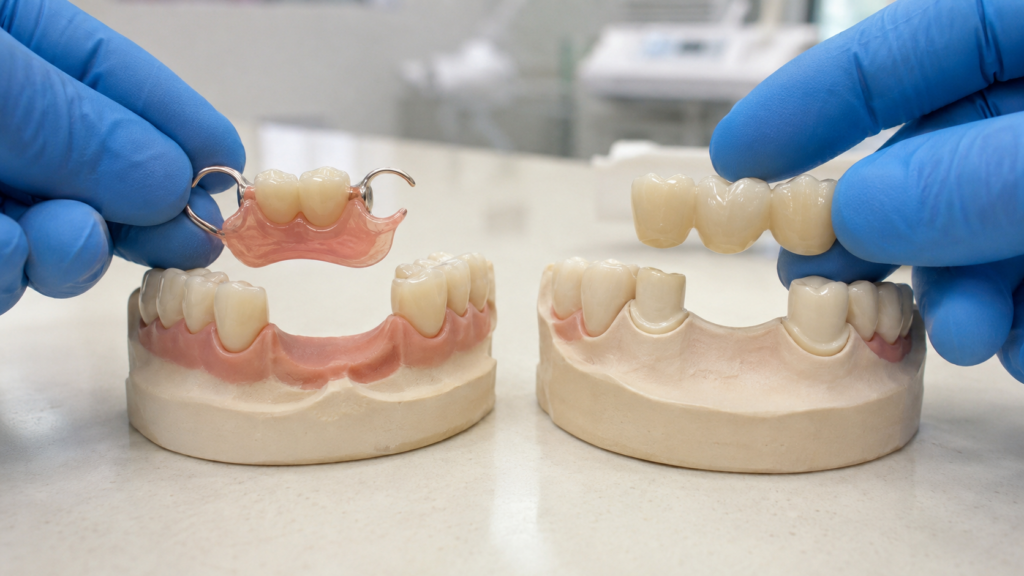
What Is a Partial Denture?
A partial denture is a removable appliance that replaces one or more missing teeth while some natural teeth remain.
Its design depends on where the missing teeth are located and what support is available from the remaining teeth and oral tissues.
Because the appliance is removable, patients take it out according to the care instructions provided by their dental team.
A partial denture can sometimes address several missing teeth, including spaces in different areas of the mouth, within one appliance. That can make it a practical option in situations where a fixed bridge would not address the entire pattern of tooth loss.
Stillwater Dental Associates confirms partial, full, immediate, and implant-supported dentures among its restorative services.
What Is a Dental Bridge?
A dental bridge replaces a missing tooth or selected missing-tooth spaces with a restoration designed to remain in place.
A traditional bridge commonly relies on suitable neighboring teeth for support.
Stillwater Dental Associates also confirms cantilever and implant-supported bridge options. These designs are planned differently, and not every patient is a candidate for every type of bridge.
The appropriate bridge design depends on factors such as the location of the missing teeth, available support, bite, and condition of the rest of the mouth.
Partial Denture vs. Dental Bridge: What Are the Main Differences?
| Factor | Partial Denture | Traditional Dental Bridge |
| Removability | Removed by the patient | Designed to remain fixed in place |
| Missing teeth | May replace multiple teeth in different areas | Commonly used for selected missing-tooth spaces |
| Support | Works with remaining teeth and oral tissues | Relies on suitable supporting teeth |
| Cleaning | Appliance is removed for cleaning | Cleaning occurs around and beneath the fixed restoration |
| Daily routine | Requires placement, removal, and appliance care | Remains in the mouth |
| Planning | Depends on remaining teeth, tissues, missing-tooth pattern, and preferences | Depends on suitable support, location, bite, and overall oral health |
Neither option is automatically better.
The more useful question is which design fits the patient’s dental condition and daily needs.
How Do the Number and Location of Missing Teeth Matter?
The pattern of tooth loss can strongly influence treatment planning.
A bridge may be appropriate for a selected missing-tooth space when suitable support is available.
A partial denture may be useful when several teeth are missing, especially when the spaces occur in different areas of the mouth.
However, there is no fixed number of missing teeth that automatically determines the answer.
Two people missing the same number of teeth may receive different recommendations because the locations of the spaces, condition of their remaining teeth, bite, gum health, and available support are different.
How Do Your Remaining Teeth Affect the Choice?
The teeth that remain are an important part of both treatment options.
For a traditional bridge, the dentist needs to determine whether the supporting teeth are appropriate for the planned restoration.
A partial denture also interacts with existing teeth, so their position and condition can affect its design and fit.
This is why tooth replacement involves more than filling an empty space.
The dentist considers how the proposed restoration will function within the rest of the mouth.
Which Is Easier to Clean?
The cleaning routines are different rather than universally easier or harder.
Because a partial denture is removable, the appliance can be taken out for cleaning. The remaining natural teeth and gums still require regular home care.
A dental bridge stays in place. Patients therefore need to clean their natural teeth while also paying attention to the areas around and beneath the restoration.
Your dental team can explain techniques that fit the specific restoration you receive.
Neither a partial denture nor a bridge is maintenance-free. Your ability and willingness to follow the required daily routine can therefore be part of the treatment discussion.
Which Option Is More Comfortable?
Comfort depends on the patient and the restoration.
A partial denture may require an adjustment period while you become accustomed to placing, removing, speaking, and eating with the appliance.
A fixed bridge can also feel different initially as you adjust to the restoration.
Fit, design, anatomy, bite, and location can all influence the experience.
Neither option should be described as feeling exactly like natural teeth for every patient. If a restoration becomes uncomfortable or does not function as expected, the dental team should evaluate it.
Is a Partial Denture Better for Several Missing Teeth?
A partial denture can be a practical option when several teeth are missing because one removable appliance may replace teeth in more than one area.
But several missing teeth do not automatically mean a partial denture is the best option.
The dentist may still consider:
- Where the spaces are located
- How many natural teeth remain
- The health of those teeth
- Gum health
- Bite and function
- Available support
- Oral hygiene
- Patient preferences
In some circumstances, bridges or other restorative options may also be discussed.
Is a Bridge Better for One Missing Tooth?
A traditional bridge may be considered for a single missing-tooth space when suitable supporting teeth are available.
That does not mean every single missing tooth should receive a bridge.
The condition of the neighboring teeth, bite, location of the space, overall oral health, and the patient’s preferences all matter.
A bridge is therefore one possible solution rather than an automatic rule for one missing tooth.
What About Implant-Supported Options?
Some tooth-replacement plans use dental implants for support rather than relying only on natural teeth or removable appliances.
Stillwater Dental Associates confirms implant-supported bridges and implant-supported dentures.
These options differ from conventional partial dentures and traditional bridges, so their planning involves additional considerations.
Whether an implant-supported restoration is appropriate depends on the individual patient’s oral health, anatomy, missing-tooth pattern, and overall treatment plan.
The available information does not establish routine in-house implant placement, so the article should not imply that Stillwater Dental Associates performs implant surgery as part of every implant-supported restoration.
Does Your Bite and Gum Health Matter?
Yes. Tooth replacement needs to work within the rest of the mouth.
The dentist may consider how the upper and lower teeth contact each other, how forces are distributed during chewing, and whether the proposed restoration can function appropriately within the existing bite.
Gum and supporting-tissue health also matter.
If you have bleeding, swelling, tenderness, or another oral-health concern, it may need to be evaluated before or alongside restorative treatment.
A comprehensive dental evaluation can help determine whether the mouth provides an appropriate foundation for the proposed restoration.
What Is the Treatment Process Like?
Partial dentures and bridges involve different planning and fabrication steps.
A traditional bridge may involve preparing suitable supporting teeth and creating the fixed restoration.
A partial denture requires designing and fabricating an appliance that fits the patient’s mouth and works with the remaining teeth and tissues.
The number of appointments and treatment sequence can vary.
Other dental needs may also influence timing, so patients should receive expectations based on their individual treatment plan rather than a universal timeline.
How Long Does a Partial Denture or Bridge Last?
There is no single lifespan that applies to every restoration.
Longevity can be influenced by:
- Oral hygiene
- Condition of supporting teeth
- Gum and tissue health
- Bite
- Daily habits
- Fit
- Maintenance
- Changes in the mouth over time
Regular dental care gives the dental team an opportunity to monitor both the restoration and the surrounding teeth and tissues.
Rather than relying on a guaranteed number of years, ask what maintenance and follow-up are appropriate for your particular restoration.
What Questions Should You Ask Before Choosing?
Before deciding between a partial denture and bridge, consider asking:
- Which option fits the location of my missing teeth?
- Are my remaining teeth suitable for supporting a bridge or partial denture?
- How would each option affect my daily routine?
- How would I clean each restoration?
- How might my bite affect the decision?
- What treatment process would each option involve?
- Are implant-supported options relevant to my situation?
- Are there other tooth-replacement approaches I should consider?
The purpose of these questions is not to choose the option that sounds easiest in general. It is to understand why one treatment may fit your specific dental situation better than another.
Partial Denture or Dental Bridge: Which Is Right for You?
Partial dentures and dental bridges can both replace missing teeth, but they do so differently.
A partial denture is removable and may replace several missing teeth within one appliance. A traditional bridge remains fixed in place and requires suitable support.
The better fit depends on the number and location of missing teeth, remaining natural teeth, gum health, bite, maintenance needs, treatment goals, and personal preferences.
Stillwater Dental Associates has served Bangor since 1975 and offers a broad range of restorative options while emphasizing practical, personalized dentistry and long-term patient relationships.
If you are comparing tooth-replacement options, contact Stillwater Dental Associates to schedule an evaluation and discuss which approach may fit your needs.